





U.S. stocks remain lower Tuesday morning as investors eyed strong consumer spending in September and the resulting risk of another Federal Reserve interest rate rise while they also sifted through more earnings beats reported by big banks.
How are stocks are trading
- The S&P 500 dipped 10 points, or 0.1%, to 4,362
- The Dow Jones Industrial Average fell 65 points, nearly 0.2%, to 33,919
- The Nasdaq Composite fell 61 points, or 0.4%, to 13,506
On Monday, the Dow Jones Industrial Average
DJIA
rose 314 points, or 0.93%, to 33,985, the S&P 500
SPX
increased 46 points, or 1.06%, to 4374, and the Nasdaq Composite
COMP
gained 161 points, or 1.2%, to 13,568.
What’s driving markets
Tuesday continued the march of third quarter corporate earnings results. About 10% of the S&P 500 is due to report this week, and the majority of those who have already done so have beaten expectations on both earnings and revenues, according to Richard Hunter, head of markets at Interactive Investor.
Results from JPMorgan Chase
JPM,
Citigroup
C,
and Wells Fargo
WFC,
were mostly well-received by traders on Friday. Now it’s the turn of their bold-faced peers, including Goldman Sachs
GS,
and Bank of America
BAC,
and BNY Mellon
BK,
to release numbers. All three produced results beating Wall Street consensus.
Johnson & Johnson
JNJ,
and Lockheed Martin
LMT,
also published results in the morning, while Omnicom
OMC,
and Interactive Brokers
IBKR,
will release reports after the closing bell.
However, in data reported Tuesday morning, U.S. September retail sales were stronger than expected, raising the possibility of another interest rate hike by the Federal Reserve in its quest to lower inflation.
Retail spending in September surged, with an 0.7% jump that beat forecasts. Stripping out auto sales, retail sales still popped 0.6% last month. Economists polled by the Wall Street Journal expected a 0.2% increase.
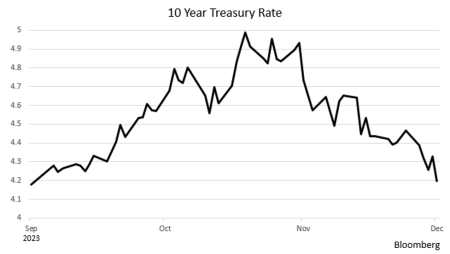
Afterwards, Treasury yields were poised to touch 16- and 17-year highs. The 10-year Treasury note
BX:TMUBMUSD10Y
climbed 13 basis points to hit around 4.84%, nearing a level last seen in early August 2007.
See: U.S. retail sales rise sharply due to strong car sales and higher gas prices
Traders say there’s a nearly 88% chance the Fed sticks with its current federal funds rate, according to the CME FedWatch Tool. That’s pretty good odds of a hold, but it’s still down from Monday, when traders wagered a nearly 95% chance of another pause on rates.
Investors have speeches from Fed officials they can parse Tuesday. The Fed officials in line to speak include John Williams, New York Fed president, talking at the the Economic Club of New York at 8 a.m.; and Richmond Fed President Tom Barkin making comments on the economic outlook at 10:45 a.m.
“Consumer spending shows little sign of flagging,” said Robert Frick, corporate economist at Navy Federal Credit Union. There may be signs of sagging credit card use and a switch to cash with more debit card use. “As long as the jobs market remains healthy, consumers should have the cash and confidence to maintain spending,” Frick said.
Investors have to navigate the good news coming out of earnings reports against the headwinds from Treasury yields, said Andres Garcia-Amaya, founder and CEO of Zoe Financial.
The strong retail sales are good news, as Garcia-Amaya views it. “It’s another indicator that a recession is not happening” and is another data point for the soft-landing camp that thinks the Fed can pull off interest rate increases without an economic downturn.
Even though retail sales exceeded expectations, Garcia-Amaya didn’t see them as a “blow-out.” That’s a good thing because too much would be too inflationary. So Tuesday’s stock market noise connected to retail sales would lessen as investors turned back to earnings reports, he said.
In other economic data points, U.S. home builder confidence fell to its lowest level since January. U.S. industrial output increased 0.3% in September, beating a forecasted 0.1% increase.
Meanwhile, news that U.S. President Joe Biden will visit Israel and neighboring countries in coming days has helped calm nerves that the Israel-Hamas conflict will cause a greater conflagration in the region.
“The recent risk-off sentiment that had cast a shadow over the markets seems to be easing, partly due to extensive shuttle diplomacy by the White House and other regional actors,” said Stephen Innes, managing partner at SPI asset Management.
Though Innes added: “Nevertheless, this optimism comes before Israel launches its ground offensive in Gaza, and this development could swiftly sour sentiment once more.”
Companies in focus
-
Bank of America Corp.
BAC,
+2.24%
stock rose nearly 0.9% in early Tuesday trading after it reported said a rise in clients and accounts across its business helped boost its third-quarter profit. -
Johnson & Johnson’s
JNJ,
-0.43%
stock fell 1.2% Tuesday morning, after the medtech and drug company posted better-than-expected third-quarter earnings and raised its profit guidance. -
Lockheed Martin Corp.
LMT,
+2.50%
climbed 1.3% after the defense manufacturer said Tuesday it had net income of $1.7 billion, or $6.73 a share, in the third quarter, compared with income of $1.8 billion, or $6.71 a share, in the year-earlier period. -
Goldman Sachs Group Inc.
GS,
-0.59%
stock was slipped 1.6% after reporting a lower third-quarter profit but managed to beat reduced earnings expectations on Tuesday.
Read the full article here