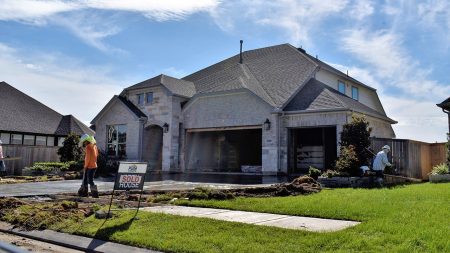







A mortgage is a government-subsidized forced savings plan — not the wealth machine Wall Street and policymakers want you to believe it is (and what they themselves might mistakenly believe it is).
According to the Fed, the median value of a home minus the mortgage was about $130,000 for a household reaching retirement age — 55 to 64 in — 1989. A little over thirty years later, the same group had more home equity, about $200,000, if they had a house — and 28% didn’t. But even though home equity was higher, this age group in 2022 had far fewer defined benefit plans and only about $185,000 in a retirement account (if they had an account — and 43% of households had nothing in theirs).
But a house is important. You have to live somewhere. And for millions of Americans, getting a mortgage is a sign of adulting — a way to plant roots, build a life and, if the real estate ads and pundits are to be believed, build lasting wealth.
Good reasons to own a house are stability and forced savings. Building retirement wealth? Not so much.
The mortgage has some value in creating wealth. The rich borrow money to make money. The working class can leverage just like the rich with a mortgage.
But if the following is true — your home doesn’t appreciate; the interest rate and carrying costs are too high; you have to move for a job, for love, for school or in a crisis; and you borrow for vacations, cars or tuition — then buying and leveraging could be a disaster wealth-wise.
Buying a house can be a very leveraged, illiquid and misunderstood commitment.
Understanding what you are actually buying — and what the government is actually subsidizing — is essential before you sign on the dotted line or before we as a nation make big public policy decisions about how workers can build wealth and security.
The Government Built This System, But Not For TRhe Reasons You Think
The mortgage interest deduction, the Federal Housing Administration (FHA), and government-sponsored enterprises like Fannie Mae and Freddie Mac are three pillars of American housing policy. Their guarantees to lenders lower the interest rates on mortgages; reduces the down payment; and spreads repayments over 30 years.
But this system was not designed originally to help workers.
The mortgage interest deduction traces back to the Revenue Act of 1913, which allowed broad interest deductions to simplify the treatment of business versus personal debt — at a time when most Americans rented and mortgages were unusual. The rich owned, workers rented.
It was the FHA, created in 1934 under FDR’s New Deal, which began to transform homeownership in America because the construction industry needed a boost and banks were hurting.
Before the FHA, mortgages required 50% down payments, came due in five years as balloon loans, and were non-amortizing — meaning your monthly payments covered only interest, and the principal never shrank. When the loan came due, you either refinanced or handed the bank the keys; there was no mechanism by which simply paying your bill each month made you any richer.
The 1929 crash had triggered mass foreclosures, collapsed construction, and wrecked banks. The FHA changed the terms of the deal to help banks survive and builders build.
The program insured lenders against default, enabling 80% loan-to-value mortgages with 20 to 30-year amortization at fixed rates. Fannie Mae, created in 1938 expanded mortgages by creating a secondary market so local banks could sell mortgages and keep lending. Freddie Mac was added in 1970 to extend that market to conventional loans.
The Generous Pro-Housing Tax Deduction Most Working Americans Can’t Use
The combined effect of FHA insurance, the secondary market, and the mortgage interest deduction translates to roughly a 0.5 to 1.5 percentage point reduction in borrowing costs — a direct and ongoing federal subsidy to mortgage borrowers. It is real money.
But the benefit of the mortgage interest deduction is not real money for most working Americans. The benefits go to the highest income Americans.
Here is a number that should stop you cold: after the 2017 Tax Cuts and Jobs Act (TCJA) roughly doubled the standard deduction, the share of Americans claiming the mortgage interest deduction collapsed from about 31% of all filers to fewer than 10%. And of those who still claim it, 95 cents of every dollar of benefit flows to households earning more than $100,000.
Consider a median-income married couple — let’s call them a household earning $105,000 — who buys a house today for $800,000. At a 6.23% mortgage rate they put 20% down ($160,000) and borrow $640,000 on a 30-year fixed. Their monthly principal and interest payment is roughly $3,975, or about $47,700 per year. In Year 1, they’ll pay approximately $40,000 in interest.
Now watch what happens at tax time. They add up their itemized deductions: $40,000 in mortgage interest, plus their $10,000 SALT cap (property taxes are capped at $10,000 for federal purposes post-TCJA), for a total of $50,000. The 2026 standard deduction for married filing jointly is approximately $32,300 (the One Big Beautiful Bill Act made TCJA provisions permanent). So, their itemized deductions exceed the standard deduction by roughly $17,700 — and at a 22% marginal federal rate, the mortgage interest deduction saves them around $3,894 a year, or about $325 a month.
That is something, but it is hardly a transformative subsidy — and it evaporates if you move to a less expensive state or a less expensive house. For a couple earning the same $105,000 income in Texas who buys a more typical $400,000 home, the math gets worse: their Year 1 interest is around $21,000, property taxes add another $6,800, but with no state income tax their total itemized deductions come to only $27,800. The 2026 standard deduction ($32,300) is higher. The mortgage interest deduction is worth exactly zero. The government created a homeownership subsidy that, for most Americans buying modestly priced homes, does not exist.
And the benefit shrinks every year you own the home. Because mortgages are amortizing, the interest portion of each payment declines over time. By year 20, the annual interest paid on that $640,000 loan has fallen from $40,000 to around $35,000 — and by years 27 to 28, the deduction barely clears the standard deduction threshold. The mortgage interest deduction is most valuable in the earliest years, when homeowners are most cash-stressed.
In contrast, take someone who bought a $3 million home — two professional earners, a household pulling in $500,000 a year. They put 20% down ($600,000) and borrow $2,400,000 on a 30-year fixed at the same 6.23% rate. Their monthly payment is roughly $14,900, or about $178,800 per year. In Year 1, they pay approximately $149,500 in interest.
At tax time, the math is entirely different. They itemize: $750,000 is the mortgage debt cap under TCJA, so they can only deduct interest on the first $750,000 of the loan — but that still yields roughly $46,700 in deductible interest. Add the $10,000 SALT cap, and their itemized deductions total $56,700. That easily clears the $32,300 standard deduction, so they itemize without a second thought.
Now here’s where the regressivity bites. Their marginal federal rate is 35%. That same deduction structure — worth $3,894 to the median couple — is worth approximately $16,345 to them. The high-income household in a $3 million home receives four times the federal subsidy for buying a home that costs nearly four times as much, paid for by a tax code that rewards the bracket you’re in as much as the interest you pay.
And unlike the median couple, this benefit doesn’t evaporate. They will itemize every year, in every state, on every house at this price point. The deduction is a permanent, reliable feature of their tax planning — not an arithmetic accident that disappears the moment they buy somewhere affordable.
The Magic of Leverage And Why It Can Blow Up in Your Face
To understand why mortgages were supposed to democratize wealth, you have to understand leverage. Wealthy investors use it across every asset class: private equity firms buy companies with 60–70% debt; commercial real estate can be acquired with 20–30% down; affluent investors can borrow on margin to amplify stock market returns. For ordinary Americans, a primary residence is essentially the only subsidized leveraged investment available.
Leverage math is compelling. Suppose you pay all cash for an $800,000 house that appreciates 5% in a year, producing a $40,000 gain. That’s a 5% return on your $800,000 — the same as a Vanguard index fund, but with the added benefit of having somewhere to live. Now suppose instead you put 20% down ($160,000) and borrow $640,000. That same $40,000 gain is now a 25% return on your $160,000 invested. Five-to-one leverage converts a 5% asset return into a 25% equity return.
Leverage math is the reason real estate feels like a wealth machine!
But there is a number missing from that calculation: the cost of the debt itself. Borrowing $640,000 at 6.23% costs roughly $40,000 in interest in Year 1. So, the same year your appreciation produced a $40,000 gain, the bank collected $40,000 for letting you use their money. Your net return, before maintenance, insurance, or property taxes is close to zero.
Leverage didn’t create wealth in Year 1 — it mostly transferred your appreciation to your lender. The equity return looks dramatic on paper precisely because the interest cost is invisible in the headline number.
This is why time horizon matters so much. In the early years of a mortgage, interest payments are at their peak and principal paydown is at its slowest — the amortization schedule is structured almost entirely in the bank’s favor. The leverage math becomes genuinely favorable later in the loan, or if appreciation significantly outpaces your interest rate.
At 6.23%, you need homes to appreciate a lot more than 6.23% just to break even on the cost of borrowing. The asset has to do the real work and if you borrowed when home prices were frothy it will be hard to get that steady annual appreciation.
And leverage is symmetrical. It amplifies losses exactly as aggressively as it amplifies gains. A 15% price decline on that $800,000 home produces a $120,000 loss against a $160,000 down payment — wiping out 75% of your equity. A 20% decline, common in the worst markets of 2008 and 2009, leaves you with approximately $7,000 in equity on a home you spent $160,000 to purchase. The wealth machine works in reverse just as efficiently — and in a downturn, the bank still collects its interest while your equity evaporates.
Nationally, U.S. home prices have declined significantly in a handful of episodes over the past 50 years. The Great Financial Crisis produced a peak-to-trough decline of roughly 30% in national home prices from 2006 to 2012, with the hardest-hit markets in Nevada, Florida, and Arizona falling 50% to 60%. That single episode generated 9.3 million foreclosures — out of approximately 75 million homeowners at the time, roughly one in eight. Inflation-adjusted home prices also declined meaningfully in the early 1980s (down approximately 13% in real terms and again in the early 1990s following the savings and loan crisis).
Outside these periods, national nominal prices have been positive roughly 89% of years since 1950 — though that figure masks enormous regional variation and ignores the real, inflation-adjusted picture, which is far less impressive.
Key Takeaways
The mortgage system was built to expand credit, stabilize banks, and support construction— not to guarantee wealth for households.
And yet, millions of Americans still believe that homeownership is the safest path to getting rich.
In Part 2, I look at the actual returns to housing—what homes really earn after inflation, costs, and behavior—and why the story most Americans are told does not match the data.
Read the full article here