




Armenia and Azerbaijan are set to sign a deal in the White House on Friday that will see a contested regional transit corridor be rebranded as the “Trump Route for International Peace and Prosperity” — a move the US president has billed as both a commercial venture and a diplomatic breakthrough.
The leaders of the two southern Caucasus nations are expected to sign a joint peace declaration, but not a full accord, which includes the establishment of the corridor bearing the US president’s name. The route will connect Azerbaijan with its exclave Nakhchivan, through the territory of southern Armenia.
“By locking in this path to peace, we are unlocking the great potential of the South Caucasus region in trade, transit and energy flows,” said White House press secretary Anna Kelly on Friday.
The project, which is expected to eventually include a rail line, oil and gas lines, and fibre optic lines, will consist of a “multimodal transit area” that will allow “unimpeded connectivity” between the territories, while respecting Armenia’s sovereignty, the White House said.
The corridor is expected to be run by a private company. Negotiations on who will operate the route are set to begin next week, said a senior US official who spoke on condition of anonymity.
Somewhat like the minerals deal that Donald Trump struck with Ukraine, the so-called TRIPP is a real estate transaction that seeks to parlay American commercial interests into a lasting US presence on the ground that helps to maintain peace.
Once established, it could also pave the way for neighbouring Turkey to reopen its border with Armenia, closed since 1993, further boosting trade links with central Asia and China.
Turkey’s president Recep Tayyip Erdoğan, who has good personal relations with Trump, played an active diplomatic role in helping bring the Armenian and Azerbaijani sides together.
The unresolved issue of the approximately 50km-long sliver of land — often referred to as the Zangezur corridor — had served as one of the major remaining obstacles in peace negotiations between the two former Soviet countries, which have fought several bloody wars since the collapse of the bloc.
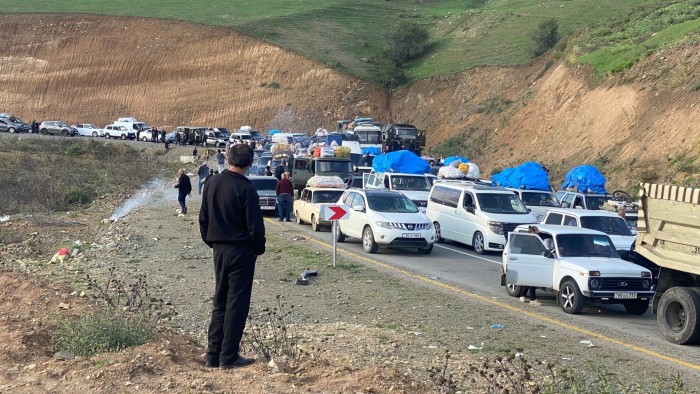
Peace talks picked up pace after the autumn of 2023, when a lightning assault by oil-rich Azerbaijan, with military support from its ally Turkey, saw it secure control over the ethnically Armenian breakaway region of Nagorno-Karabakh.
The two sides marked a first breakthrough in talks earlier this year, agreeing on the language of a future peace deal but leaving several key questions unanswered — including the future of the Zangezur route.
“The deal is more than a renaming of the Zangezur corridor as the Trump Road — it brings US presence to the heart of Russia’s hinterland and potentially creates a major new trade route between Europe and Central Asia,” said Asli Aydintasbas, a fellow at the Brookings Institution in Washington.
“It also positions the US as a guarantor for peace through a logistics hub, run by US companies,” Aydintasbas said.
Until recently, it was “not impossible to imagine Azerbaijan using regional chaos as an opportunity to militarily grab” territory in southern Armenia, Aydintasbas added. But with “the US entering the fray as a commercial actor”, that idea of “military conquest” is put to rest.
The deal marks a major new US commitment to the region.
Washington’s increased involvement also underscores Russia’s declining role. Moscow’s influence has waned in the two countries since at least 2020, when its traditional ally Armenia was defeated by Azerbaijan on the battlefield. Regional players have also increasingly perceived it as distracted and weakened by the war in Ukraine.
“It’s a game-changer for the region, in terms of connectivity and normalisation,” Elin Suleymanov, Azerbaijan’s ambassador to the UK, told the Financial Times. Better connections through the region will create economic opportunities, he said.
At the same time, the deal takes the two countries closer to a historic peace agreement. It shows “a commitment to normalisation, to the peace process,” Suleymanov said.
But the road to a full-blown peace deal remains long. Baku also wants to see Yerevan change the language of its constitution to remove a reference that in its view enshrines a claim to Nagorno-Karabakh.
Trump has made little secret of his hopes of being awarded a Nobel Peace Prize. He pledged on the campaign trail to bring the wars in Gaza and Ukraine to a swift end, but both conflicts have so far evaded his efforts.
Special Envoy Steve Witkoff has led Trump’s diplomatic outreach in the Middle East, with Russia, and in the South Caucasus. The real estate developer flew to Azerbaijan in March to discuss deepening ties with Washington, precipitating efforts to broker a deal between Baku and Yerevan.
“As we zoomed out beyond that we said maybe there’s a moment here not for a US-Azeri reset but a regional reset,” said the senior US official.
The White House deal is also expected to see Yerevan and Baku sign a joint letter to the Organization for Security and Co-operation in Europe (OSCE) requesting it to dissolve the Minsk Group, a body it set up in 1992 to find a solution the Nagorno-Karabakh issue.
After restoring full control over the region — internationally recognised as part of Azerbaijan — in late 2023, Baku has repeatedly called for the Minsk Group to be dissolved, describing it as irrelevant. This language was echoed by the White House on Friday.
This has been welcomed by Azerbaijani officials. Putting an end to the Minsk Group “shows the era of conflict is behind us”, Suleymanov said.
“It shows we’re moving from this post-Soviet period of grinding conflict management and conflict resolution, and moving into an era of normalcy,” the ambassador said.
Data visualisation by Alan Smith
Read the full article here