





How do you price chaos? Do you buy it, sell it, or wait for something truly shocking to happen?
Those are perhaps the most critical investment questions as Hamas’ surprise attack on Israel illuminates the world’s disequilibrium.
The answers aren’t as clear as the problems. America’s domestic dysfunction has deprived the world of leadership when a strong, respected nation is most needed at the helm. Europe is weak. No happy end is in sight as Ukraine fights to repel Russia.
China is confronting its worst nightmare: a simultaneous demographic and economic crisis. The world’s second-largest economy is slowing, its population is aging, and the young are often “lying flat” rather than working. Some fret China might use the Middle East crisis as an opportunity to invade Taiwan.
We last raised a litany of major risk factors early last month. At the time, one reader cheekily noted that I had forgotten to mention a giant prehistoric sea monster might devour Wall Street. Since then, the
S&P 500 index
has declined as much as 5% and the
Cboe Volatility Index,
or VIX, has risen about 22%.
We return to those same risk factors as they threaten to overtake the market’s long-running obsession with inflation, interest rates, and parsing the laconic language of central bankers. Others will suggest octopus-like options strategies that are supposedly all things to all investors. Its very complication, they insist, will make money if stocks rally, decline, or stall.
We prefer to eat octopus rather than trade it. Instead, it is better to focus on an important fact that is rarely discussed outside of the market’s inner sanctum: Options are sometimes too expensive to buy and too cheap to sell. Now is such a time.
Implied volatility, as measured by the VIX, is hovering below its long-term average of about 19. Risks are much higher than that implies. We noted last week that a cardinal rule of investing is not losing money. Nothing has changed since then.
Regular readers of this column know that we often recommend cash-secured put sales on blue-chip stocks that ideally pay dividends. We also like selling calls on stocks one already owns to create what we call “conditional dividends” that pay investors for owning stocks. We hesitate to make those recommendations now because it is too hard to anticipate what happens next.
Goldman Sachs, for one, has advised clients that it is cautious on options selling. Since September’s expiration date, the bank’s derivatives strategists estimate that the average S&P 500 stock with liquid options is down 5.0%. Investors who sold one-month calls that were 10% above or below the average stock price outperformed by 42 basis points and put selling underperformed by 37 basis points. (A basis point is 1/100th of a percentage point.)
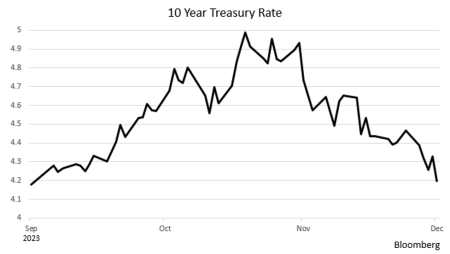
Much is being made of Tuesday’s 10-year Treasury yield declining from 52-week highs, which has sent stocks higher. We prefer to view that as a sign that Treasuries are the cleanest shirt in the dirty laundry basket. In other words, falling yields may not signal the end of rising interest rates.
A wise friend who retired from a top bank once remarked that there are three people in every transaction: the client, the broker, and the bank. If two of the three are making money, he said, it is a good trade.
Until the odds swing back to you, the client, it is hard to ignore the appeal of safe money-market funds or short-term Treasuries that pay around 5% and allow you to watch the world’s chaos bully the stock market. The time will come for action. It always does. Be ready.
Steven M. Sears is the president and chief operating officer of Options Solutions, a specialized asset-management firm. Neither he nor the firm has a position in the options or underlying securities mentioned in this column.
Email: [email protected]
Read the full article here