






Investing in the Schwab U.S. Dividend Equity ETF (NYSEARCA:SCHD) may seem like a good idea for investors looking to receive a steady stream of income from dividends. But despite the superficially attractive dividend promise, the SCHD dividend proposition may actually be very bad relative value, insufficiently rewarding investors for their money. In this article, I will discuss a few considerations why I believe this is the case.
Treasuries Offer Higher Yields
Firstly, and most importantly, the relative attractiveness of investing in SCHD versus Treasuries is very low, if not non-existent. The reasoning is simple: Currently, both short-dated and long-dated Treasuries offer a higher yield compared to the SCHD ETF — and this also at lower risk. For reference, the 10-year treasury yield is now trading close to 5%, easily topping the approximately 3.8% dividend benchmark that investors expect from investing in SCHD.
Now, investors may argue that equities have better value appreciation potential than Treasuries. Although this is true most of the time, it is currently likely not the case. Investors should consider that if the Fed is to cut rates by about 100-125 basis points over the next 12 months (which is my personal base case assumption), then a portfolio holding 10-year Treasuries may appreciate close to 10% in value on an effective portfolio duration of approximately 8. And the more the Fed cuts, the more will Treasuries appreciate in value. I doubt that dividend-focused equities can offer investors a competitive value appreciation skew.
Expanding on the risk argument, investors should note that unlike the yield on Treasuries, the yield on SCHD’s investment is not guaranteed. In fact, if the economy suffers and company earnings contract, dividends may be cut or eliminated. This consideration is especially relevant now, with economists still debating about the likelihood of a pro-longed economic downturn.
On a more complex argumentative basis, investors should also consider that if a recession starts, and prices of stocks decline, some executives may decide to cut dividends in order to buy back shares of their stock at lower prices. While there is nothing wrong with this decision, it may have negative implications for SCHD. Specifically, if dividend investing goes out of fashion, the stocks that SCHD has to choose from, because of the way of its rigid index methodology, may decline in quality.
Lastly, investors should also note that the key reason why prices of the stocks making up SCHD should rise is based on investors’ willingness to pay more for shares. This means that the value of SCHD’s investment is dependent on the market’s perception of the value of the underlying stocks. If investors lose confidence in the market or the economy, the value of SCHD’s investment may decline.
SCHD’s Core Holdings Are Cyclical …
Secondly, SCHD’s investment strategy is focused on slow-growing, cyclically exposed businesses. This means that the ETF is heavily invested in companies that are sensitive to economic cycles, such as consumer discretionary, financials, and industrials. In fact, the four major cyclical industries including Industrials, Energy, Consumer Cyclical and Financials account for more than 60% of the SCHD portfolio.
Seeking Alpha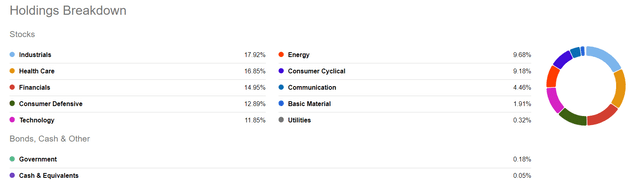
Now, while these sectors may perform well during an economic expansion, they are likely to suffer during a recession. In line with this, I argue that it is highly questionable whether cyclical businesses, which are the focus of SCHD’s investment strategy, merit an implicit growth premium, especially now as the FED aims to cool the economy.
… And Likely Not Deserve A Growth Premium
I have already argued that SCHD’s investment strategy is focused on slow-growing, cyclical businesses. But the implications of this asset focus extend beyond the risk of cyclical growth in the economy. Specifically, investors should consider that the SCHD’s investment strategy may not be able to take advantage of emerging trends or explosive growth opportunities. To give some context, SCHD’s investment strategy is based on a rigid index methodology that must pick stocks based on certain criteria. This means that the ETF may not be able to take advantage of emerging trends or opportunities that fall outside of its index methodology, like for example taking advantage of the enormous AI growth potential. As per SCHD’s investment mandate:
The investment seeks to track as closely as possible, before fees and expenses, the total return of the Dow Jones U.S. Dividend 100™ Index. To pursue its goal, the fund generally invests in stocks that are included in the index. The index is designed to measure the performance of high dividend yielding stocks issued by U.S. companies that have a record of consistently paying dividends, selected for fundamental strength relative to their peers, based on financial ratios.
Referencing the SCHD investment strategy, two key considerations stand out why significant, emerging growth potential disqualifies a stock from being held by SCHD. First, emerging growth companies are not listed in the Dow Jones U.S. Dividend 100™ Index; and secondly, emerging growth companies do not have the capital nor the financial/ commercial position to have a record of consistently paying dividends.
The argument that SCHD lacks implied growth potential is evidenced by the ETF’s YTD performance, with SCHD being down almost 8% since the start of the year, as compared to a 38% gain for the growth-focused Nasdaq 100 (QQQ).
Seeking Alpha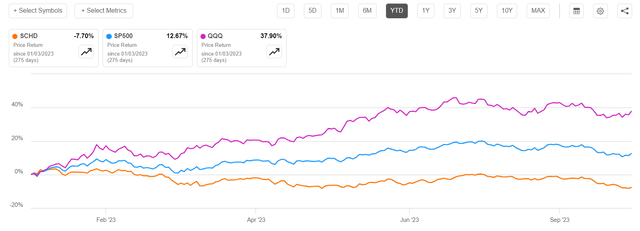
Not Everything Is Bad
To be clear, I am not saying SCHD is a bad investment per se; I am just saying it is a bad investment relative to other opportunities in the market. And as markets change, e.g., bond yields drop, SCH may once again shine as a great vehicle to provide investors with exposure to a consistent stream of income. Moreover, investors should also note that the arguments of my analysis are time-sensitive. Specifically, SCHD ETF may indeed be well suited for very long-term focused investors, who sit out the compounding effect of reinvested dividends and the potential for capital appreciation. Lastly, I point out that SCHD holds a portfolio of stocks from various sectors and industries, which can provide diversification benefits. Diversifying your investments can help spread risk and reduce the impact of poor-performing stocks.
Investor Takeaway
In conclusion, while investing in the Schwab U.S. Dividend Equity ETF may seem like a good idea for investors looking for a steady stream of income from dividends, there are several reasons why investing in SCHD may currently not be the best option for investors. In my opinion, the most notable anti-argument for SCHD is the relative underperforming yield versus Treasuries. But also an important consideration is that SCHD’s investment strategy is focused on slow-growing, cyclical businesses, which may not offer the same potential for growth as other types of investments. Finally, the yield on SCHD’s investment is not guaranteed, and complex relationships may cause loss of value for investors. I am clearly, and confidently, sell-rated on SCHD.
Read the full article here